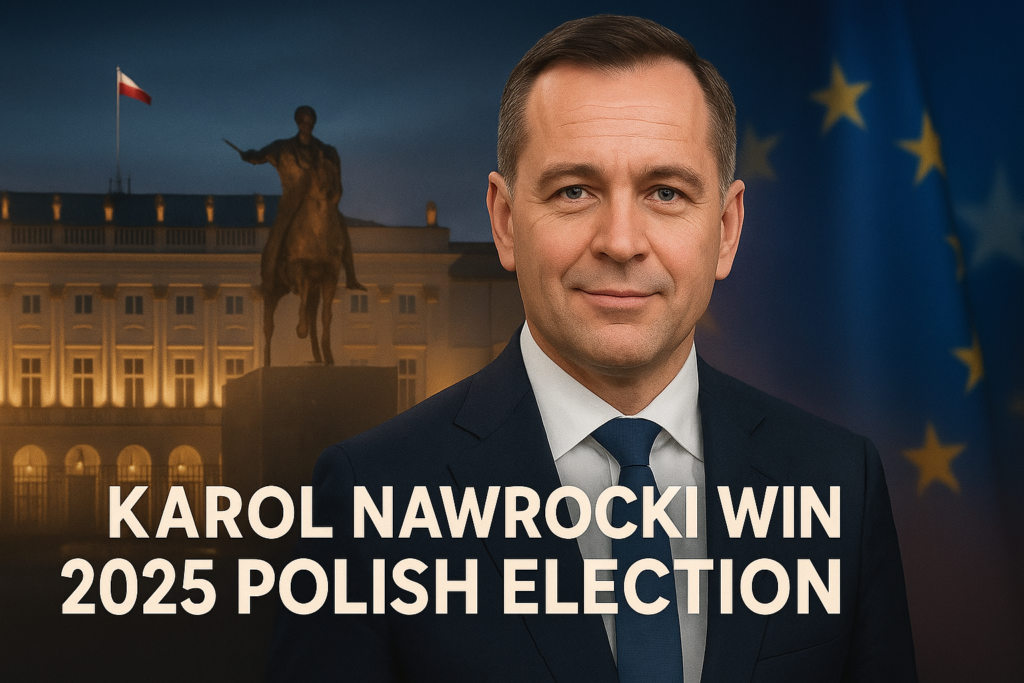
Poland welcomed a new president on June 2, 2025, as Karol Nawrocki, a conservative historian backed by the Law and Justice (PiS) party, won a closely fought election. Nawrocki’s victory over Rafal Trzaskowski, the liberal Warsaw mayor, marks a shift in Poland’s political landscape, raising questions about its ties with the European Union. The tight race, with Nawrocki securing 50.89% of the votes, has sparked debates across Europe and the UK about Poland’s future direction.
A Hard-Fought Election
The 2025 Polish presidential election was a nail-biter. In the first round on May 18, 2025, Trzaskowski led with 31.4% of the vote, while Nawrocki trailed closely at 29.5%, eliminating 11 other candidates.
The second round on June 1 was even closer. Early exit polls suggested Trzaskowski might win, but final results confirmed Nawrocki’s victory with 50.89% to Trzaskowski’s 49.11%.
Nawrocki, 42, celebrated with supporters in Warsaw, promising to prioritize Polish interests. The win is a blow to Prime Minister Donald Tusk’s pro-EU government, which backed Trzaskowski.
Nawrocki, a former head of Poland’s Institute of National Remembrance, built a tough-guy image during his campaign, sharing videos of himself at shooting ranges and boxing rings. His nationalist stance resonated with voters who want policies favoring Poles over others, including Ukrainian refugees.
Meanwhile, Trzaskowski, a key figure in Tusk’s Civic Platform (PO), campaigned on strengthening Poland’s role in the EU. The close result shows a divided nation, with urban voters favoring Trzaskowski and rural areas leaning toward Nawrocki.
Nawrocki’s Background and Promises
Karol Nawrocki, a relatively unknown figure months ago, rose quickly in Polish politics. A historian by training, he led efforts to preserve Poland’s historical memory, focusing on its struggles against communism and foreign influence.
His campaign emphasized “Poland first” policies, promising economic and social benefits for Poles. He vowed to protect traditional values, echoing the PiS party’s past governance from 2015 to 2023, which tightened abortion laws and increased state control over media.
Unlike some eurosceptic leaders like Hungary’s Viktor Orban, Nawrocki supports military aid to Ukraine against Russia’s invasion.
However, he opposes Ukraine’s membership in Western alliances like NATO or the EU, reflecting declining support among some Poles for Ukrainian refugees. His stance has drawn attention across Europe, with many watching how he’ll balance Poland’s EU membership with his nationalist agenda.
International Reactions and US Ties
Nawrocki’s campaign gained a boost from the United States. In May 2025, he met former President Donald Trump at the White House, who endorsed him.
US Homeland Security Secretary Kristi Noem also urged Poles to elect Nawrocki, citing his ability to work with Trump. With 10,000 US troops stationed in Poland, Nawrocki’s presidency could strengthen US-Poland military ties.
A White House X post on May 2, 2025, shared: “President Donald J. Trump welcomes Polish presidential candidate Karol Nawrocki to the Oval Office 🇺🇸🇵🇱”.
European leaders have mixed reactions. The Czech Republic’s president congratulated Nawrocki, but Tusk’s government fears challenges ahead.
As president, Nawrocki can veto budgets, potentially triggering early parliamentary elections before 2027. This power could disrupt Tusk’s pro-EU reforms, making governance tricky for Poland, the EU’s sixth-largest economy.
What This Means for Poland and Europe
Nawrocki’s win strengthens PiS’s influence, offering the party hope of regaining power after losing the 2023 parliamentary election.
His eurosceptic views may strain Poland’s ties with the EU, especially on issues like judicial reforms and migration. However, his support for Ukraine’s military aid keeps Poland aligned with Western security goals. Across Europe, leaders are watching closely, as Poland’s direction could influence EU unity.
In the UK, where many Poles live, the election has sparked discussions about migration and EU relations. An X post by @EuropeElects on June 1, 2025, noted: “Poland, Final results: Nawrocki (PiS-ECR): 50.89%, Trzaskowski (PO-EPP): 49.11%”.
For young voters in Europe and the UK, Nawrocki’s presidency raises questions about Poland’s role in a changing world. Will he push for national pride at the cost of EU ties?
Can he balance support for Ukraine with domestic concerns? These issues will shape Poland’s future and its place in Europe.
A Divided Nation Moves Forward
The election revealed Poland’s deep divisions. Urban areas backed Trzaskowski’s vision of a pro-EU future, while rural voters supported Nawrocki’s focus on Polish identity.
As Nawrocki takes office, he faces the challenge of uniting a polarized country while navigating international pressures. His presidency could reshape Poland’s policies on everything from migration to economic growth, impacting millions at home and abroad.