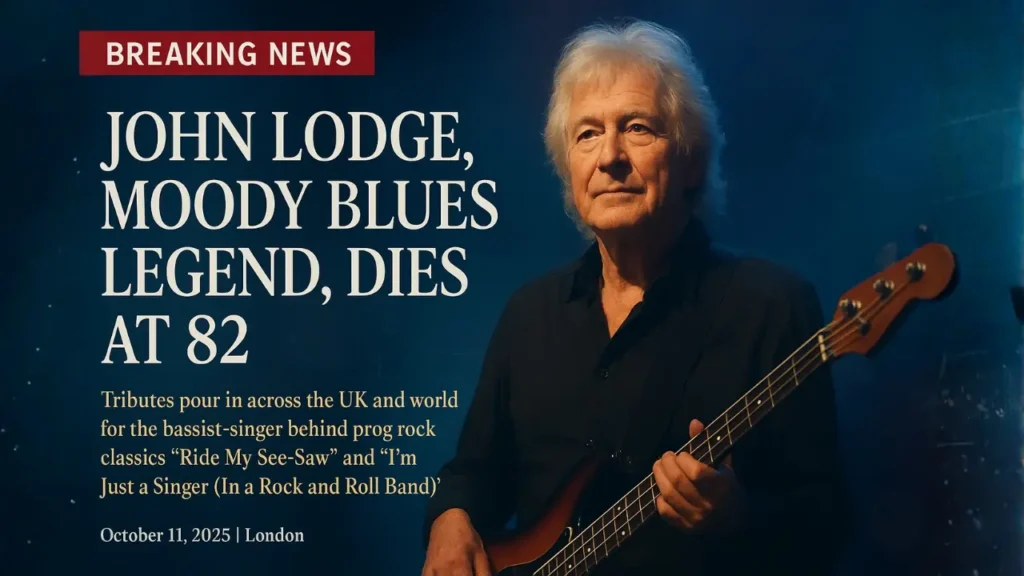
John Lodge, the longtime bassist and singer for The Moody Blues, died suddenly and unexpectedly on October 10, 2025, at the age of 82.
His family announced the news on social media, saying he “peacefully slipped away surrounded by his loved ones and the sounds of The Everly Brothers and Buddy Holly.”
Lodge, a key architect of the band’s lush, orchestral sound that defined progressive rock, leaves behind a wife, two children, a grandson, and a legacy of timeless hits.
Fans and fellow musicians across Europe and the UK share heartfelt tributes, reflecting on his massive-hearted spirit as of 10:45 AM IST today, Saturday, October 11, 2025.
Family’s Heartfelt Statement
Lodge’s family expressed profound grief in their announcement.
“It is with the deepest sadness that we have to announce that John Lodge, our darling husband, father, grandfather, father-in-law and brother, has been suddenly and unexpectedly taken from us,” they wrote.
They highlighted his enduring love for wife Kirsten—married since 1968—and his family, including daughter Emily, son Kristian, and grandson John-Henry.
“As anyone who knew this massive-hearted man knows, it was his enduring love of his wife, Kirsten, and his family that was the most important thing to him, followed by his passion for music and his faith,” the statement continued.
They added, “We will forever miss his love, smile, kindness, and his absolute and never-ending support.
We are heartbroken, but will walk forwards into peace surrounded by the love he had for each of us. A
s John would always say at the end of the show, thank you for keeping the faith.”
No cause of death was disclosed, but the family emphasized his joy in performing with the band, his son-in-law Jon Davison (Yes vocalist), and sharing music with fans.
Lodge, an Evangelical Christian, credited his faith with helping him avoid rock’s excesses.
Lodge’s Life and Early Influences
Born John Thomas Lodge on July 20, 1945, in Erdington, Birmingham, England, Lodge grew up in a working-class family and attended Birches Green Junior School, Central Grammar School, and Birmingham College of Advanced Technology.
He developed a love for music early, inspired by boogie piano greats like Fats Domino and Jerry Lee Lewis, which shaped his driving bass style.
Lodge bought his first Sunburst Precision Bass in Birmingham as a young musician and joined local bands before linking up with The Moody Blues in 1966.
He replaced Clint Warwick alongside singer/guitarist Justin Hayward after the departure of Denny Laine and original bassist.
The lineup then included Lodge, Hayward, drummer Graeme Edge, keyboardist Mike Pinder, and flutist Ray Thomas.
Lodge stayed with the band for over 50 years, until their final live performances in 2018, contributing to 16 studio albums.
Career Highlights with The Moody Blues
Lodge helped transform The Moody Blues from their R&B roots—with the 1964 hit “Go Now”—into pioneers of psychedelic and progressive rock.
Their breakthrough came with the 1967 album Days of Future Passed, the first full collaboration with the London Festival Orchestra, featuring the iconic “Nights in White Satin” (Hayward’s lead vocal, Lodge’s harmonies).
It blended pop songs with symphonic elements on four-track tape, a groundbreaking feat.
Lodge wrote and sang lead on classics like “Ride My See-Saw” (1968, from In Search of the Lost Chord), “Isn’t Life Strange” (1972), “I’m Just a Singer (In a Rock and Roll Band)” (1973, a Top 20 US hit), “Steppin’ in a Slide Zone” (1978 comeback single), “Talking Out of Turn” (1981), “Sitting at the Wheel” (1983), and “Here Comes the Weekend” (1988).
His songs often featured rich, layered vocals and experimental sounds, like the eight-track recording of “Ride My See-Saw.”
The band’s 1960s-70s albums, including On the Threshold of a Dream (1969), To Our Children’s Children’s Children (1969), A Question of Balance (1970), Every Good Boy Deserves Favour (1971, with “Emily’s Song” for his daughter), and Seventh Sojourn (1972), sold platinum in the US.
After a 1974-78 hiatus, they returned with Octave (1978), embracing pop, and continued until December (2003 Christmas album). I
nducted into the Rock & Roll Hall of Fame in 2018, The Moody Blues influenced prog rock with their “Moodiness”—hymnal vocals, flute, and studio wizardry.
Tributes from Bandmates and Fans
Justin Hayward, Lodge’s bandmate of 58 years, posted on Facebook, “I’m very sad and shocked to hear of John’s passing.
He was my brother in every way that mattered.” Hayward recalled their shared history, from joining in 1966 to the Vegas residency ending their touring days.
Fans and peers mourned widely. Heart’s Ann Wilson, who inducted them into the Hall of Fame, called Lodge a “survivor of psychedelia’s golden age.”
Rolling Stone remembered his “supple bass lines and soaring falsetto harmonies.”
On X, a fan posted, “RIP John Lodge—’I’m Just a Singer’ will always make me tear up” .
Another shared, “Moody Blues lost a giant—Lodge’s bass drove those epic tracks” .
Personal Life and Later Years
Married to Kirsten since 1968, Lodge had two children, Emily and Kristian, and worked with them on music projects.
He released solo albums like Natural Avion (1977) and Blue Jays with Hayward (1975). I
n 2023, he reimagined Days of Future Passed as a solo EP. Lodge viewed music as transportive: “One note can take you somewhere… that’s psychedelic.”
A Birmingham City supporter, he dreamed of his grandson John-Henry playing for the club.
Why Lodge Mattered
The Moody Blues, often underrated, sold millions with their symphonic prog-pop, rivaling McCartney’s longevity. L
odge’s innovations—layered vocals, unusual setups—pioneered the genre.
His death closes a chapter for British rock, but his songs endure.
Stay tuned for funeral details.